AI for Cash Flow Forecasting and Predictive Liquidity Management
Predict collection timing, test funding pressure and make earlier liquidity decisions—with a worked rupee example, scenario analysis and essential treasury controls.
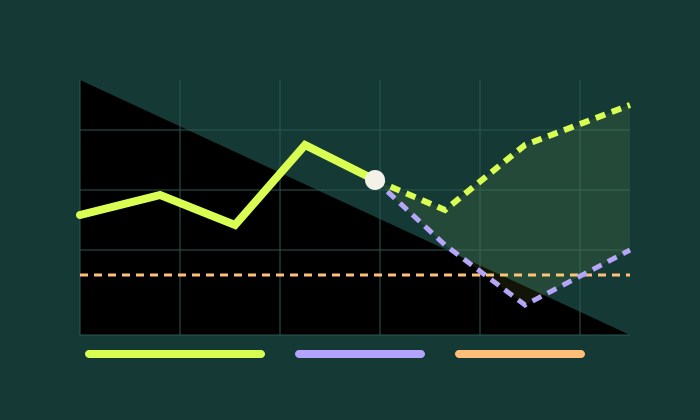
A profitable business can still struggle to pay salaries if collections arrive after its obligations fall due. Cash forecasting asks when money is likely to arrive and leave. Predictive liquidity management uses that view to identify funding pressure early and evaluate available responses.
AI can help estimate customer payment timing, identify recurring patterns and surface changes in expected cash flows. It cannot guarantee collections, create an available credit facility or remove management’s responsibility for funding decisions.
Know the likely cash position, the uncertainty around it and the time available to respond before a shortfall becomes urgent.
Forecast cash, not accounting profit
Begin with reconciled available cash. Add expected receipts and subtract expected payments by period. Distinguish operating flows, financing and other movements, and identify restricted funds separately. Depreciation is not a cash payment; an unpaid sale is not a collection.
Available liquidity = Unrestricted usable cash + Eligible drawable facilities
These are simplified planning relationships. Facility availability depends on the agreement, draw conditions, covenants, limits and timing. Avoid double counting an overdraft, internal transfer or funding draw.
A rolling short-term view, such as 13 weeks, can support operational decisions; daily detail can matter near a funding pinch. A longer monthly forecast supports broader planning. Choose horizons suited to the business rather than treating one format as mandatory. ICAI’s treasury resources provide background on cash-management principles. [4]
Where AI adds practical value
Predict the timing of receipts
Invoice due dates describe contractual expectations. Actual behaviour can vary by customer, dispute status, season and collection history. A predictive model can estimate likely collection timing using relevant, authorised data. New customers, changed terms and large disputed balances need explicit attention rather than blind reliance on a historical average.
Identify patterns in outgoing payments
Models can help classify bank transactions and detect recurring payments. Known obligations—payroll, debt service, approved supplier commitments and statutory payments—should remain anchored to confirmed schedules. A historical pattern is not a sufficient basis for omitting a new obligation.
Explain movements and flag pressure
AI can draft a forecast-variance narrative from verified calculations and identify which assumptions changed. Require it to distinguish timing shifts from permanent changes and facts from hypotheses. Treasury should own the approved forecast and decisions.
Documented product examples
Oracle Predictive Cash Forecasting describes daily, weekly or monthly rolling forecasts, multiple forecasting methods and receivables predictions based on customer payment behaviour. Its documentation also describes scenarios, variance analysis and drill-down. The cited 25C release note describes controlled-release eligibility, Cloud ERP/EPM setup and an EPM Enterprise subscription requirement. Confirm the current release and entitlement with Oracle before treating it as an immediately available feature. These are described capabilities, not a guarantee of forecast accuracy for a particular business. [1]
SAP’s Cash and Treasury Assistant describes support for cash positioning, forecast timing and early identification of funding needs. SAP’s cash-management materials also describe consolidating positions and simulating future cash flows. Actual features depend on product configuration and access; a suggested transfer should still follow treasury authority. [2] [3]
A worked liquidity example
Illustrative amounts below are in ₹ lakh. Assume opening unrestricted cash of ₹20 lakh and a management-approved minimum cash buffer of ₹10 lakh. The table is a three-week excerpt from a larger rolling forecast, before any new financing.
| ₹ lakh | Week 1 | Week 2 | Week 3 |
|---|---|---|---|
| Opening cash | 20 | 25 | 3 |
| Expected receipts | 30 | 18 | 35 |
| Expected payments | 25 | 40 | 20 |
| Closing cash | 25 | 3 | 18 |
| Headroom above ₹10 buffer | 15 | −7 | 8 |
Week 2 remains positive at ₹3 lakh but falls ₹7 lakh below the chosen buffer. It is a buffer breach, not automatically an inability to pay. Within-week timing could still create a separate payment problem even if the week-end balance is positive.
If ₹8 lakh of expected Week 2 collections shifts into Week 3, Week 2 closing cash becomes −₹5 lakh. Restoring the ₹10 lakh buffer at that point would require ₹15 lakh of funding or equivalent cash improvement, assuming other inputs are unchanged. This is a downside scenario, not a claimed probability.
Possible responses include verified collection follow-up, review of discretionary expenditure and assessment of eligible funding. Do not assume suppliers can be paid late without contractual or legal consequences. Model each approved response, including financing costs and later repayments.
Build a dependable forecasting workflow
| Stage | Key action | Evidence or control |
|---|---|---|
| Position | Reconcile opening balances by bank, entity and currency. | Identify restricted cash, unpresented items and data freshness. |
| Obligations | Load receivables, payables, payroll, debt and other commitments. | Reconcile source totals and avoid duplicate cash flows. |
| Prediction | Estimate uncertain payment timing or recurring flows. | Retain model version, assumptions and known exceptions. |
| Scenarios | Stress collections, sales, costs and funding availability. | Separate assumptions from approved actions; capture dependencies. |
| Review | Treasury challenges material assumptions and overrides. | Keep rationale, owner and approval history. |
| Refresh | Replace elapsed forecasts with actuals and roll forward. | Explain forecast error and update the next decision point. |
Internal transfers may affect entity-level cash without changing consolidated cash. Currency conversion can obscure a local-currency shortfall. Keep those views separate and check whether cash can actually move between entities or accounts.
Evaluate the forecast before trusting the model
Compare AI with a sensible baseline, such as due dates adjusted by observed collection patterns or an existing rules-based forecast. Test using only information available at each historical forecast date. Including future receipts, later dispute resolutions or revised records in a backtest creates data leakage and can make performance look unrealistically good.
Measure receipts and payments separately as well as net closing cash: offsetting errors can make the net position look accurate. Review absolute errors, persistent over- or under-forecasting and performance at the decision horizon. Percentage errors can become unstable when actual flows are near zero.
Track how often shortfall alerts were useful, how many breaches occurred without sufficient warning and how quickly teams acted. If you display prediction intervals, check their observed coverage. Do not label arbitrary best- and worst-case assumptions as statistically calibrated confidence intervals.
Controls for predictive liquidity management
- Restrict access to bank data, payment records and credentials; use approved integrations.
- Separate forecasting from payment execution and borrowing authority.
- Document facility eligibility, funding lead times and permitted uses.
- Keep overrides visible with a reason, owner and expiry or review date.
- Escalate stale data, broken feeds and unusual forecast changes.
- Review model behaviour when customer terms, seasonality or business structure change.
A chatbot can help explain a forecast, but arithmetic should run in controlled spreadsheet formulas or code. A language model’s confident narrative does not establish that borrowing is available or that a payment decision is appropriate.
A practical starting point for a CA or finance team
Build a reconciled rolling cash forecast from approved bank, receivable and payable exports. Separate committed flows from estimated flows, define the minimum buffer and assign collection and payment assumptions to owners. Add AI first where uncertainty is meaningful and outcomes can be checked—such as likely collection timing or variance explanations.
Start in decision-support mode. Evaluate accuracy and usefulness over repeated cycles before expanding automation. The value is earlier, better-evidenced decisions about liquidity, rather than an attractive chart that conceals uncertain inputs.