How to Create a CV and Apply for Jobs Using AI: Pros, Cons and Prompts
Use AI to organise your experience, tailor a CV and prepare applications—without inventing credentials. Includes copy-ready prompts, a review checklist and practical pros and cons.
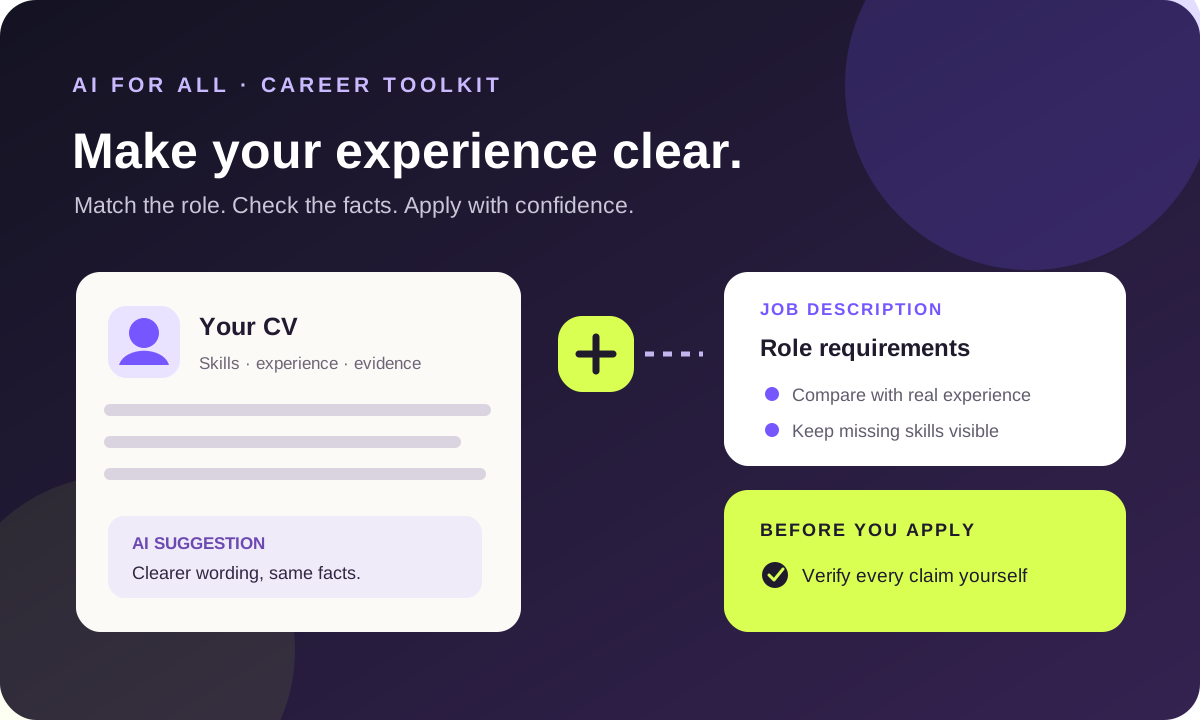
AI can help you turn work history, projects and skills into a clear CV, tailor an application to a role and practise for interviews. It can organise your material and improve wording, but it cannot verify your experience or guarantee an interview. You must check every claim before submitting it.
A practical AI-assisted job application workflow
- Gather accurate source material. List your roles, dates, responsibilities, education, projects, tools and achievements. Note which details you can support with examples.
- Choose a specific role. Read the job description and identify the essential responsibilities, skills, location and application instructions.
- Ask AI to organise your experience. Request a skills-and-evidence map that connects requirements to facts already in your notes. Ask it to show gaps instead of filling them in.
- Draft and tailor the CV. Use AI to improve clarity and structure, then adapt the relevant sections for the role. Keep the original facts and your own voice.
- Prepare a cover message and interview practice. Ask for a concise draft and role-specific practice questions. Review the wording and prepare genuine examples from your experience.
- Verify and submit. Check names, dates, qualifications, links, file format and the employer’s instructions. Save the submitted version and record the date and next step.
Where AI can help
| Task | Useful AI assistance | Your review |
|---|---|---|
| CV structure | Group experience, education, projects and skills under clear headings. | Confirm the order fits your career stage and the role. |
| Role matching | Compare a job description with evidence in your CV and flag missing requirements. | Separate skills you have from skills you still need to develop. |
| Achievement writing | Turn rough notes into concise, action-oriented bullet points. | Check that every result, number and responsibility is true and supportable. |
| Cover letter or email | Prepare a first draft that connects your experience to the position. | Personalise it and remove generic claims or invented knowledge of the employer. |
| Interview preparation | Generate practice questions, run a mock interview and help structure answers. | Use real examples and check any technical or industry-specific answer. |
Copy-ready prompts
1. Map the role requirements to your evidence
Compare this job description with my CV notes. Create a table with: requirement, evidence I have provided, strength of match and information still needed. Do not assume I have a skill or experience that is not stated. Keep gaps visible. Job description: [paste]. My notes: [paste].
2. Draft a clear CV section
Rewrite these notes as concise CV bullet points for a [job title] application. Use clear action verbs and plain professional English. Preserve the facts exactly. Do not invent metrics, clients, qualifications, tools, responsibilities or outcomes. If a measurable result would improve a bullet, ask me for the figure instead of estimating it. Notes: [paste].
3. Tailor the CV without overstating
Suggest edits to my CV for this role. Show each proposed change beside the original and explain why it is relevant. Use only information supported by my CV. Do not add keywords that imply experience I do not have. Keep the wording natural and easy to verify. CV: [paste]. Job description: [paste].
4. Draft a short application message
Draft a concise application email for [role] at [employer]. Use only these verified details about my experience: [details]. Mention why the role interests me using the information I provide: [reason]. Do not invent familiarity with the company, make claims about my suitability that lack evidence, or promise anything. Leave placeholders for missing details.
5. Practise for an interview
Run a mock interview for [role] at [level]. Ask one question at a time and wait for my answer. After each answer, give feedback on clarity, relevance and evidence. Do not write an answer for me unless I ask. Help me improve the response using a real example from my experience: [brief notes].
Pros and cons of using AI for job applications
| Potential advantages | Limitations and risks |
|---|---|
| Helps organise a large amount of experience into a clearer first draft. | May invent details, inflate achievements or misstate a qualification if the prompt is vague. |
| Can adapt wording to a particular job description and highlight relevant evidence. | Repeatedly tailoring with no human judgement can make applications generic or keyword-heavy. |
| Provides a low-pressure way to practise interview questions and refine explanations. | Suggested answers may sound rehearsed and may not reflect how you would speak naturally. |
| Can help people who find writing or structuring a CV difficult. | Language and formatting suggestions can contain errors or remove important context. |
| Speeds up routine editing and proofreading. | Sharing a CV or personal history with an AI service can create privacy risks; tool data terms differ. |
Important checks before you apply
- No invented credentials: Do not add degrees, licences, software skills, job titles, dates, clients or results that are not true.
- Check every number: Confirm percentages, revenue figures, team sizes and dates against your records. If you cannot substantiate a metric, leave it out.
- Keep the CV readable: Use consistent headings and a simple layout. Application systems and employer preferences differ, so follow the stated instructions and do not assume one format works everywhere.
- Protect personal information: Share only what is needed with the AI tool. Avoid uploading identity numbers, bank details, private references or confidential employer information. Check the tool’s data-handling settings and terms.
- Verify the vacancy: Confirm the role and application channel through the employer’s own careers page or a trusted recruiter. Be cautious if someone asks for money or sensitive documents unusually early.
- Keep your voice: Read the final CV and application aloud. Make sure you can explain every sentence in an interview.
Use AI as an assistant, not as the applicant
A strong application is specific, truthful and relevant. AI can help you get from rough notes to a polished draft, but the evidence, choices and final submission should remain yours. Keep a copy of the CV you submitted and prepare to discuss the experience behind each claim.