Your Roadmap to AI Mastery: ten steps to learn, apply and improve
Use the illustrated ten-step roadmap to build practical AI skills—with exercises, milestones and a daily 30-minute learning routine.
AI proficiency grows through practice on tasks you understand, careful review and gradual improvement. Use this ten-step roadmap to move from experimentation to dependable everyday workflows. It is a learning path, not a promise of mastery within a fixed number of days.
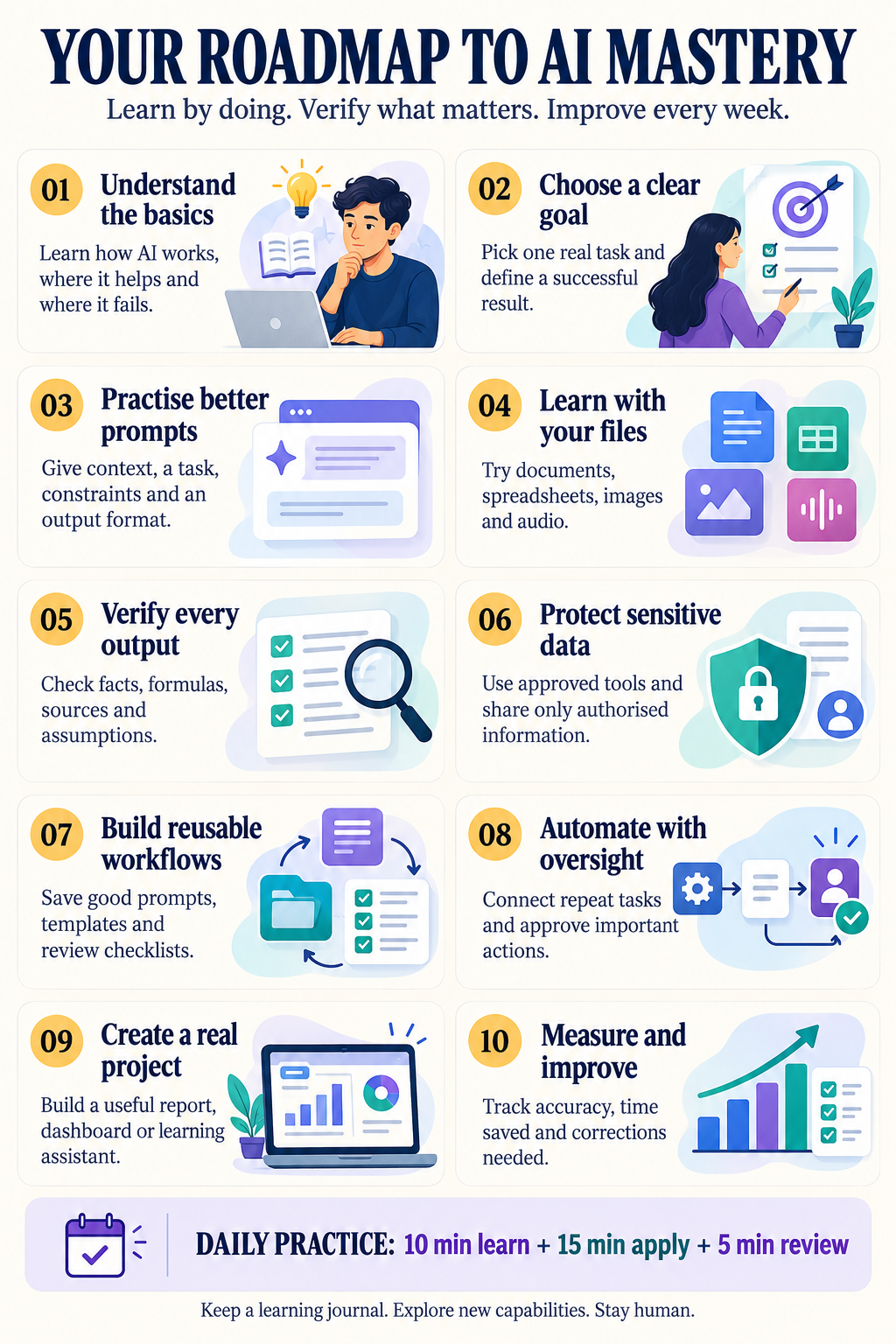
The ten steps—put into practice
Work through the steps at your own pace. Repeat an exercise until you can explain both why the output is useful and how you checked it.
Understand the basics
Learn how AI works, where it helps and where it fails.
Practise: Ask an assistant to explain a familiar topic, then identify a factual statement you can independently check. Learn to distinguish a generated answer from verified evidence.
Milestone: Explain three useful capabilities and three limitations in your own words.
Choose a clear goal
Pick one real task and define a successful result.
Practise: Choose a task you already understand, such as drafting a client query list, summarising approved notes or creating a study plan. Define the audience, required facts and acceptance criteria.
Milestone: Write a one-sentence goal and a short review checklist.
Practise better prompts
Give context, a task, constraints and an output format.
Practise: Run the same task with a vague instruction and then a structured brief. Compare relevance and the editing required. Refine the largest gap with a targeted follow-up.
Milestone: Save one prompt that reliably produces a useful first draft.
Learn with your files
Try documents, spreadsheets, images and audio.
Practise: Use authorised sample material. Ask for page or cell references, uncertain readings and missing information. Check which input types your selected tool actually supports.
Milestone: Complete a small file-based exercise and compare the result with the original.
Verify every output
Check facts, formulas, sources and assumptions.
Practise: Open cited sources, recalculate totals and challenge any explanation that goes beyond the supplied evidence. Ask the assistant to separate facts, assumptions and unanswered questions.
Milestone: Keep a brief record of what you verified and what you corrected.
Protect sensitive data
Use approved tools and share only authorised information.
Practise: Review your organisation’s rules and the selected account’s data settings before client work. Use synthetic examples for practice and exclude unnecessary identifiers, credentials and confidential details.
Milestone: Write down which data you may use and which inputs require approval.
Build reusable workflows
Save good prompts, templates and review checklists.
Practise: Turn a successful exercise into a repeatable sequence: input preparation, AI instruction, output review and approved final result. Make missing information an explicit exception.
Milestone: Create a reusable template with a human review step.
Automate with oversight
Connect repeat tasks and approve important actions.
Practise: Start with a draft-producing workflow. Define who reviews it and when the process must stop. Review permissions before connecting accounts; keep consequential messages, payments and record changes behind explicit approval.
Milestone: Document the trigger, input, review gate and manual fallback.
Create a real project
Build a useful report, dashboard or learning assistant.
Practise: Choose a bounded project that solves your original goal. For example, create a management-commentary draft from an approved spreadsheet or build a study assistant from your own notes.
Milestone: Finish one project and show how its output was checked.
Measure and improve
Track accuracy, time saved and corrections needed.
Practise: Compare the whole workflow with your manual process, including input preparation and review. Record errors, editing time and recurring gaps. Retest when instructions, source material or tools change.
Milestone: Keep a learning journal and choose one improvement for the next week.
30 focused minutes.
Learn
Study one concept or useful technique.
Apply
Try it on a small, realistic task.
Review
Check the result and record one lesson.
Keep a learning journal. Explore new capabilities. Stay human.
A practice brief you can reuse
Help me complete [TASK] for [AUDIENCE]. Use only [APPROVED INPUTS]. Produce [FORMAT] within [CONSTRAINTS]. Flag missing information and unsupported assumptions. Show the checks I should perform before using the result.
For professional work, start with anonymised or synthetic exercises and independently review material conclusions. For personal use, begin with writing, learning or planning tasks where you can easily assess the result.