Humanoids today: real work, remarkable skills and the world’s robot arenas
What humanoid robots can actually do in October 2026: 10 documented cases, global competitions, an official workplace video and a practical guide to separating progress from hype.
Humanoids have crossed an important threshold: some now do useful, paid work in real facilities. Others can tidy a room, talk to visitors or compete on a running track. The fascinating part is how uneven these abilities remain. A robot that runs brilliantly may struggle with a crumpled towel; one that chats naturally may have no practical walking ability.
A human-shaped body, several very different jobs
A humanoid has a body or upper body that resembles the human form: a torso, arms and often a head and legs. Some platforms use wheels; some social robots remain stationary. “Humanoid” describes the embodiment, not a certified level of intelligence.
Why build one? Our workplaces already have human-height shelves, handles, aisles and tools. A human-like form can potentially use that infrastructure. The trade-off is complexity: balancing a tall machine while it reaches, carries and avoids people is hard. A wheeled cart or fixed industrial arm may still be the better solution for a particular task.
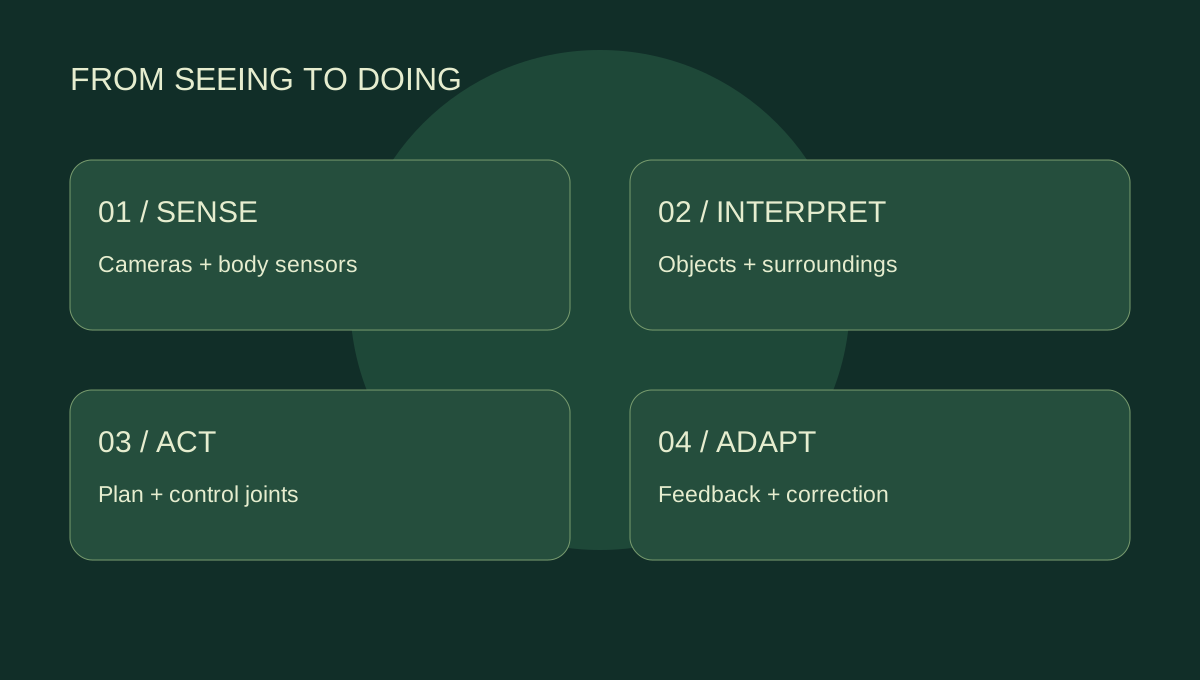
How a robot turns a request into movement
Sensors estimate the scene and body position. Perception identifies objects and possible grips. A planning or learned policy chooses an action; controllers command joints while feedback corrects motion. Vision-language-action systems can connect visual observations and language with physical behaviour. A language model’s fluent answer alone does not solve balance, force control or collision avoidance.
Read the evidence before the headline
A customer uses the system in an operating workflow. Ask about scale and interventions.
A real facility tests a defined job. This is useful evidence with bounded scope.
A task is shown or evaluated. Check conditions, failures and repeatability.
A skill is tested under rules or choreography. Control modes may differ.
These labels describe the evidence available for the case, not a universal ranking of the manufacturer. No single robot below is shown to possess every capability in this article.
10 things humanoids can do now — with real cases
“Live case” here means a named, documented real-world deployment, trial, demonstration or competition, rather than an always-on livestream. Manufacturer reports are identified as such.
Move goods through a warehouse
Digit × GXO · Georgia, USA
At GXO’s SPANX fulfilment operation in Flowery Branch, Agility’s Digit transfers totes from mobile robots onto conveyors. The customer announced a multi-year Robots-as-a-Service agreement in June 2024. This is an identifiable customer, site and repeatable workflow, rather than a stage routine. [1]
Why it matters: Walking while carrying a container links machines designed for different jobs. The useful skill is dependable handoff between systems.
Where the claim stops: The published use case concerns a defined tote-transfer process. It does not establish that Digit can independently perform every warehouse job.
Position factory parts accurately
Figure 02 × BMW · Spartanburg, USA
BMW reports that Figure 02 retrieved and positioned sheet-metal components for welding during a ten-month 2025 pilot, assisting production of more than 30,000 X3 vehicles. BMW describes weekday ten-hour shifts; that schedule should not be read as ten hours of uninterrupted battery operation. [2]
Why it matters: A body that reaches into human-designed fixtures could automate physically repetitive stations without rebuilding an entire line.
Where the claim stops: The robot supported a specific production step. It did not assemble a whole car. BMW’s later Leipzig programme uses Hexagon’s AEON, a different platform.
Recognise, carry and sequence different parts
Atlas × Boston Dynamics · USA
Boston Dynamics demonstrates electric Atlas sorting engine covers from supply containers into the order required for a manufacturing line. This combines perception, grasp selection, carrying and placement. [3]
Why it matters: Sequencing is more demanding than replaying a fixed arm movement: the robot has to relate a recognised object to the correct destination.
Where the claim stops: Treat this as evidence for the demonstrated task. The January 2026 product announcement and scheduled customer shipments do not by themselves prove mature, fleet-wide production reliability.
Use two hands around fragile objects
Figure Helix · dishwasher task
In September 2025, Figure showed Helix separating stacked plates, reorienting a glass between hands and loading a dishwasher. Its report describes recovery from grasping errors and collisions. [4]
Why it matters: The same object may need a different grip for lifting, turning and placing. Coordinating both hands is essential in kitchens and workshops.
Where the claim stops: A demonstrated loading task is narrower than a safe, universally capable kitchen assistant. No broad household service guarantee follows from the video.
Clean, tidy and handle soft materials
Figure Helix 02 · March 2026
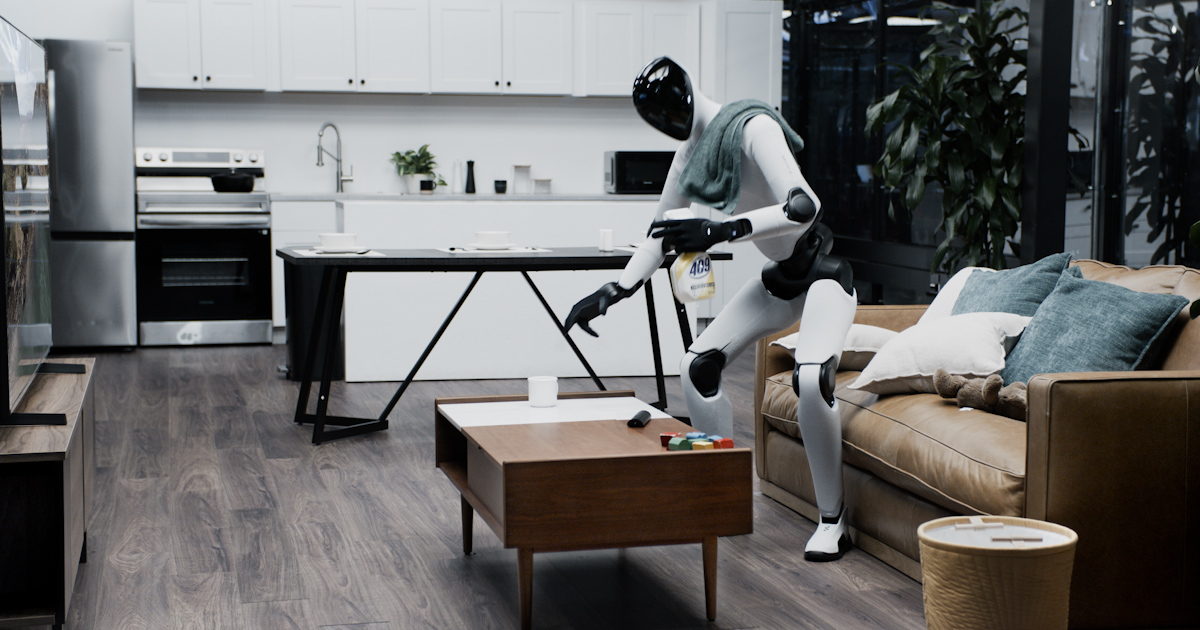
Figure’s living-room demonstration includes spraying and wiping a surface, collecting toys into a bin, repositioning a towel, returning a cushion and operating a TV remote. These actions combine movement with object handling. [5]
Why it matters: Cloth bends, cushions deform and hands become occupied. Everyday chores are difficult precisely because the world is less predictable than a fixed fixture.
Where the claim stops: The evidence is a manufacturer demonstration in a particular setting. It does not provide an independently audited success rate for every listed action.
Transfer learned skills into unfamiliar homes
Figure Helix 2.5 · September 2026
Figure reports tests across 30 previously unseen Bay Area homes for tidying, towel folding and bed making. Its controlled comparison reports zero-shot success improving from 9% to 56% with Index pretraining. [6]
Why it matters: Zero-shot here means no training data collection or adaptation in those test homes. It addresses a major weakness: robots often learn a particular room rather than a reusable skill.
Where the claim stops: The 56% is a reported evaluation result under the company’s protocol, not a promise that any household chore will succeed 56% of the time. The remaining failures also show why supervision matters.
Talk, gesture and respond socially
Ameca × Engineered Arts · UK
Ameca combines speech systems with expressive facial movements and gestures. Engineered Arts shows it interacting with visitors at events including Mobile World Congress and Bloomberg Tech Summit 2024, and describes multilingual conversational integration. [7]
Why it matters: A physical presence can make a guide, exhibit or educational encounter more engaging than a screen. The conversational model and the robot body perform different parts of the experience.
Where the claim stops: An expressive face is not evidence of feelings or consciousness. Conversation quality depends on the connected AI and knowledge sources; a social humanoid is not automatically a capable walking worker.
Dance, coordinate and execute athletic motions
Unitree G1 / H2 · China’s 2026 Spring Festival Gala
Unitree records a WuBot performance involving 24 G1 robots and one H2 at the February 2026 gala. Such routines demonstrate coordinated whole-body control, timing and dynamic balance. [8]
Why it matters: Keeping a robot stable during rapid movement is a substantial control achievement and a useful research test.
Where the claim stops: Choreography is not equivalent to spontaneous planning in an unfamiliar workplace. A successful kick or dance also says little about delicate manipulation.
Sustain running over a long course
Beijing E-Town humanoid half-marathon · China
The official April 2026 results report more than 100 humanoid teams and a winning time of 50 minutes 26 seconds for Lightning. Endurance events stress balance, navigation, hardware and recovery together. [9]
Why it matters: Long runs expose problems that a ten-second clip can hide: heat, power management, mechanical wear and route following.
Where the claim stops: Robot racing rules, permitted assistance and control modes matter. A race result is not a direct measure of general intelligence or workplace readiness; it is not a human athletics record.
Play football as an embodied team
RoboCup · Incheon, South Korea, 2026
The RoboCup Federation reports a full 11-versus-11 humanoid match in Incheon in 2026. Football requires ball perception, localisation, balance, decisions and coordination under changing conditions. [10]
Why it matters: Other players move unpredictably. The challenge is reacting in real time instead of following a pre-recorded path.
Where the claim stops: Performance depends on league rules, platform and team software. Football competence cannot be assumed to transfer directly to home care or factory work.
Watch: a humanoid doing a warehouse job
Agility’s official video shows Digit’s first day of regular work at GXO on 5 June 2024. Watch the tote handoff: the commercially interesting moment is the connection between existing mobile robots and a conveyor.
Third-party video; playback depends on the host and your browser. No autoplay. The clip documents the stated 2024 workflow, rather than every later hardware revision.The world’s humanoid proving grounds
Robot sport is entertaining because it turns engineering failure into something visible: a missed ball, a stumble or a dropped object. For researchers, these are repeatable tests of perception, balance, control and recovery. The events below are a selected international guide, not an exhaustive list or a universal leaderboard.
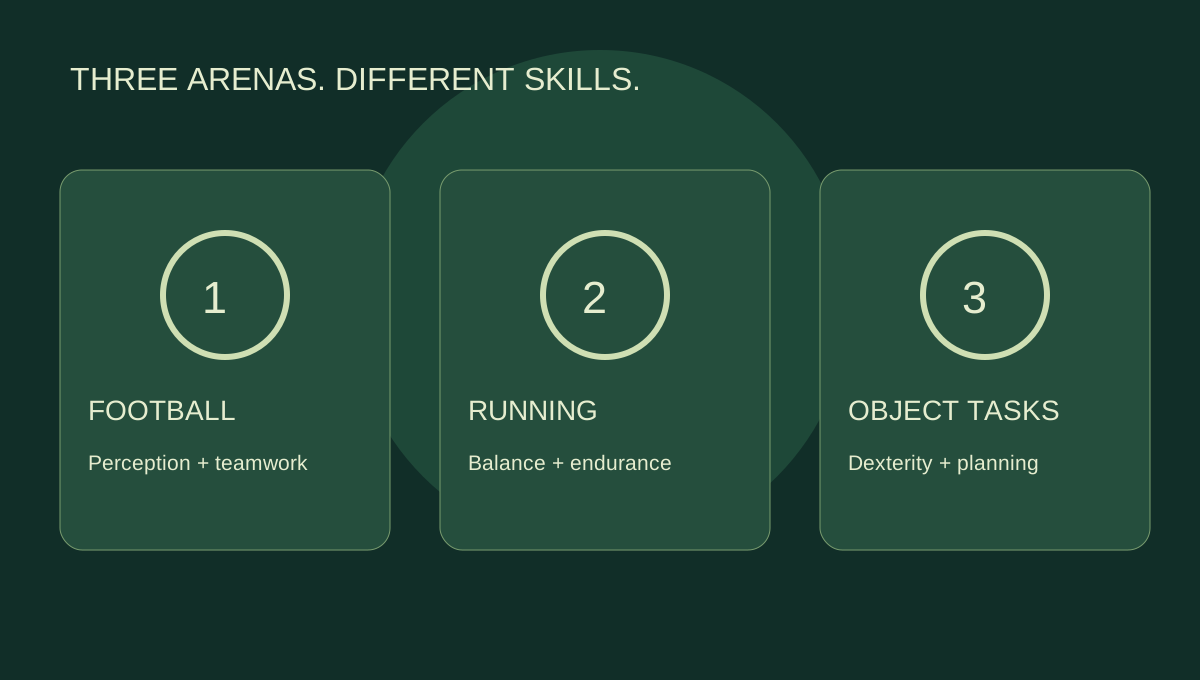
| Competition & location | What it tests | How to interpret it |
|---|---|---|
| RoboCup humanoid soccer International; 2026 in Incheon, South Korea [10] | Autonomous football, localisation, team coordination and dynamic decision-making. | A research competition with changing league structures; consult the current rulebook rather than assuming every division uses the same robot. |
| World Humanoid Robot Games Beijing, China · announced for 22–26 August 2026 [11] | Athletics, performance and scenario tasks; the official April announcement proposed real-world factory, hotel and model-home settings. This programme notice is not a results report. | Check the control rules for each event. Not every entry is fully autonomous and success in one event does not establish general capability. |
| Beijing E-Town Humanoid Robot Half-Marathon Beijing, China · 19 April 2026 [9] | Long-distance locomotion, endurance, thermal management and navigation. | A specialised endurance benchmark. Compare results only after considering assistance, interventions and category rules. |
| FIRA RoboWorld Cup — HuroCup International series with changing host countries [12] | An all-round humanoid challenge: sprint, obstacles, basketball, weightlifting and other events listed by FIRA. | Rewards versatility across events rather than a single impressive motion; categories include Kid and Adult robots. |
| ROBO-ONE / ROBO-ONE Light Japan; official 45th ROBO-ONE listed for 26–27 September 2026 [13] | Bipedal robot competition centred on fighting, balance and recovery; Light offers a separate entry route. | Control methods differ by category; remote-controlled bouts should not be described as autonomous combat. ROBO-ONE auto is a distinct format. |
| RobotChallenge — Humanoid Sprint International participants; organiser based in China [14] | A humanoid sprint category within a broader multi-event robotics competition. | Not every RobotChallenge event involves humanoids. Use the specific humanoid sprint rules when comparing entrants. |
Why are several major events in China?
This selection reflects a concentration of recently documented humanoid sport events in Beijing, alongside longstanding international research and hobbyist competitions. “Worldwide” refers to the ecosystem and participation; it does not mean there is a comparable humanoid tournament on every continent. Broader robotics expos and industrial trade fairs are not automatically humanoid competitions.
Three questions to ask about a winning robot
- Was it autonomous, remotely controlled, or using a mixture of both?
- What assistance, resets, repairs or battery changes did the rules permit?
- Was performance repeatable across runs, objects and environments?
A football winner, a boxing winner and a half-marathon winner have solved different problems. There is no meaningful single “world’s best humanoid” score across them.
What today’s humanoids still struggle with
The case evidence supports a broad conclusion: physical skills are improving, while dependable general-purpose operation remains an engineering challenge. This is an editorial assessment, not a claim that every platform shares identical limitations.
- Unfamiliar situations: a new room, reflective surface or unexpected object can change the task. Figure’s reported 30-home evaluation is progress, and its failures show the remaining gap.
- Dexterity and contact: flexible fabric, slippery dishes and irregular parts require precise grips and force control.
- Long sequences: if an individual step succeeds 95% of the time, 20 independent steps would all succeed only about 36% of the time. This is a mathematical illustration, not a measured robot result; real errors can also be correlated.
- Energy and maintenance: shift schedules do not reveal uninterrupted battery life. Charging, component wear and service access determine productive availability.
- Safe interaction: falling, pinching and collision risks must be assessed in the actual setting. A social demo is not evidence of suitability for lifting patients or supervising children.
- Economics: a low purchase price is only one input. Integration, supervision, downtime and repair can dominate the business case.
Can one replace a household helper today?
The cited demonstrations do not establish a universally reliable household replacement. A useful domestic assistant must handle varied chores, recognise dangerous situations and recover safely without frequent intervention. Doing three learned behaviours in an evaluation is an important milestone, but a narrower claim.
Can it replace an entire factory workforce?
The strongest customer-backed examples here automate specific steps. A production line also needs quality control, replenishment, exception handling, maintenance and coordination. Evaluate a robot as part of that operating system.
For businesses: buy a solved task, then expand
For a warehouse, hotel or manufacturing unit, begin with a repetitive task and a measurable baseline. This is an evaluation framework, not a claim that a particular model is commercially available in India or approved for your application.
- Define one job: specify object types, weight ranges, travel path, cycle time and acceptable quality.
- Measure human and existing automation alternatives: include output, errors, ergonomics and space requirements.
- Demand an on-site trial: include awkward but normal cases, not only the cleanest setup.
- Log interventions: record manual assists, remote support, resets and the time required to restore service.
- Calculate cost per successful task: total operating cost divided by accepted completed tasks, with comparable time periods.
- Check service and data arrangements: spare parts, local support, camera feeds, recordings, access controls and connectivity requirements.
- Expand only after evidence: add a second task once the first has reliable throughput and a credible support plan.
A robot calmly completing the same useful task all week can matter more commercially than a spectacular flip. The compelling story is now the combination of physical skill, transferable learning and dependable operation — and the evidence is strongest when all three can be measured.
Sources & further watching
Editorial review completed on 15 November 2026. Dated sources retain their original context; the World Humanoid Robot Games entry cites an advance programme notice rather than verified final results. Statements attributed to manufacturers remain company-reported unless a customer or organiser independently confirms the relevant case. Event rules and future schedules may change.
- GXO: commercial Digit deployment ↗
- BMW: Figure 02 and the Leipzig programme ↗
- Boston Dynamics: autonomous part sequencing ↗
- Figure: dishwasher loading ↗
- Figure: living-room demonstration ↗
- Figure: Helix 2.5 in 30 homes, September 2026 ↗
- Engineered Arts: Ameca ↗
- Unitree: performance milestones ↗
- Beijing: 2026 half-marathon results ↗
- RoboCup Federation ↗
- World Humanoid Robot Games 2026 programme ↗
- FIRA HuroCup: events and rules ↗
- ROBO-ONE: official tournaments ↗
- RobotChallenge: humanoid sprint ↗
- Boston Dynamics: January 2026 Atlas product announcement ↗
Editorial note: the vector visuals are original explanatory illustrations, not verified manufacturer models. The credited Figure image depicts its manufacturer demonstration. The embedded video is from Agility Robotics.