Marketing Using AI: A Complete Practical Guide
Explore 27 marketing tools, documented brand examples, ten copy-ready prompts, official video courses and a practical 30-day implementation roadmap.
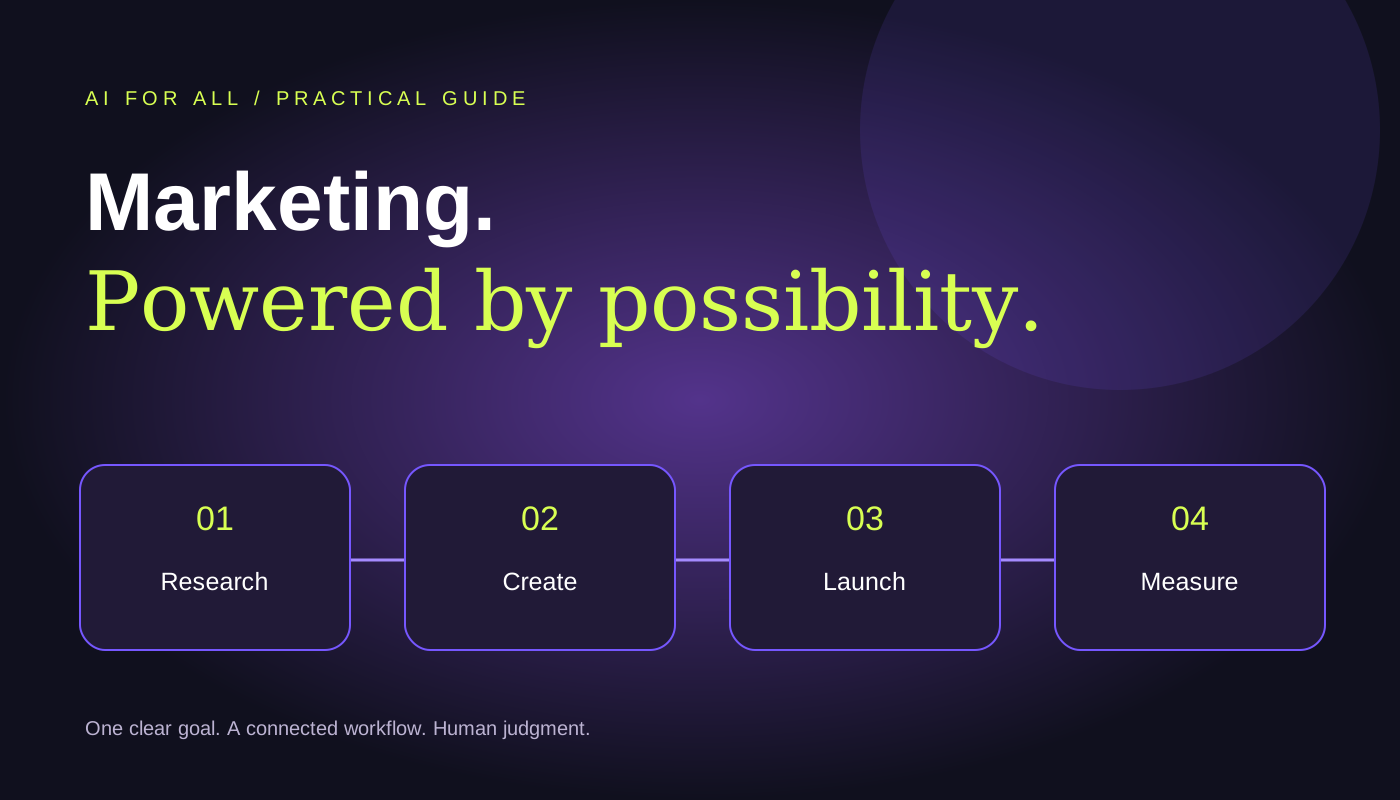
Artificial intelligence is transforming how businesses attract customers, build brands, generate leads and increase sales. Research, design, writing, advertising and analytics can be supported by connected AI workflows—with people responsible for the final decisions.
This practical guide covers 27 useful tools, real-world examples, ten reusable prompts, video learning resources and a 30-day implementation plan for businesses, professionals and agencies.
1. Twenty-seven useful AI marketing tools
These are options by workflow, rather than a ranking. Several are broader marketing platforms with AI features; capabilities, integrations and allowances depend on the plan. Start with a small stack that solves a specific problem.
| Category | Tools | Main applications |
|---|---|---|
| Content writing | ChatGPT, Jasper, Copy.ai | Draft blogs, advertisements, captions and campaign variations. |
| Graphic design | Canva AI, Adobe Firefly, Ideogram | Create and refine posters, banners and brand concepts. |
| Video creation | Runway, HeyGen, Synthesia | Produce promotional clips and presenter-led videos. |
| SEO | Semrush, Surfer SEO, Ahrefs | Research keywords, review content and investigate search visibility. |
| Social media | Buffer, Hootsuite, Predis.ai | Plan content, prepare variations and organise scheduling. |
| Email marketing | Mailchimp, ActiveCampaign | Build segmented campaigns and approved follow-up sequences. |
| CRM and lead generation | HubSpot, Zoho CRM, Apollo | Organise leads, qualify opportunities and manage follow-ups. |
| Chatbots | Intercom, Tidio, Manychat | Answer supported questions and route enquiries. |
| Analytics | Google Analytics, Microsoft Power BI | Explore conversion performance and build reporting dashboards. |
| Automation | Zapier, Make | Connect forms, CRM records, notifications and workflows. |
Use one writing assistant, one design tool, one CRM, an approved email platform and a measurement dashboard. Add video or automation after the basic workflow is reliable.
Explore our image and video tools guide for official links, visual prompts and production workflows.
2. Real-world applications
Create Real Magic
Coca-Cola’s 2023 initiative let participants create artwork using generative AI and selected brand assets. It illustrates how a brand can invite creative participation while providing a recognisable visual starting point.
Practical lesson: provide approved assets, clear rules and moderation rather than an unrestricted brand-generation exercise. This case does not establish a sales uplift.
Read Coca-Cola’s announcement ↗A.I. Ketchup
The Heinz campaign used AI-generated ketchup imagery and audience-suggested prompts to explore its visual brand identity. The campaign’s award entry describes how the generated variations became advertising material.
Practical lesson: use AI to explore an existing brand idea; review every asset before publication. A campaign description is not independent proof of commercial performance.
View the campaign entry ↗Virtual try-on
Sephora’s historical Virtual Artist launch let shoppers preview lip shades digitally. It demonstrates how computer vision and augmented reality can support product discovery; it is different from generating advertising copy or video.
Practical lesson: help customers evaluate a purchase, and explain where a digital preview may differ from the actual product. Availability varies by market and time.
Read Sephora’s historical launch discussion ↗Suggested workflow: a local hospitality business
Use verified guest feedback to identify common questions. Draft a room guide and social campaign, create approved visuals, route enquiries into the CRM and measure qualified bookings. This is an illustrative workflow, not a documented customer result.
3. Ten reusable AI marketing prompts
Replace the bracketed fields with your own details. Use anonymised inputs and verify claims before publication.
Develop a 90-day digital marketing strategy for [business], targeting [audience] in [location]. Use [budget and business facts]. Include channels, content plan, KPIs, assumptions and risks. Ask for missing essentials; do not invent customer research or expected returns.
Using [anonymised customer feedback and research], identify recurring needs, objections and buying triggers for [offering]. Separate evidence from hypotheses. Propose interview questions to validate gaps. Do not infer sensitive personal traits.
Create a four-week content calendar for [business and audience] across [channels]. For each entry give the objective, topic, format, hook, call to action, required asset and measurement. Fit [available production capacity].
Write five ad variations for [product/service] using only [verified features, offer and dates]. Give a headline, body and call to action for [platform]. Avoid guarantees, fabricated scarcity, testimonials and unsupported comparisons. Flag claims needing evidence.
Create a search-focused content brief for [topic and audience] using [verified keyword research]. Include intent, outline, questions, internal-link opportunities and evidence required. Do not invent search volumes or promise rankings.
Design a seven-post campaign for [goal and audience]. Use [brand tone and verified facts]. Provide caption, visual brief, accessible alt-text suggestion and call to action. Explain how each post supports the campaign objective.
Draft a three-email sequence for people who have agreed to receive [type of communication]. Use [offer and audience context]. Include subject lines, useful content, a clear action and an unsubscribe placeholder. Do not assume permission or claim guaranteed results.
Write a 30-second video script for [offering] using [verified facts]. Give timing, narration, on-screen text, visual direction and a closing action. Keep speaking pace realistic and mark illustrative scenes.
Draft chatbot responses using only [approved FAQs, eligibility and escalation policy]. Ask the minimum qualification questions, disclose automation, and route unknown or sensitive queries to [human contact]. Do not invent pricing or commitments.
Analyse [campaign data, period, attribution model and budget]. Reconcile spend and conversions; calculate CTR, CPC, conversion rate and acquisition cost where fields permit. Separate observed results from possible causes and propose one-variable tests. Flag missing data and avoid claiming causation from correlation.
4. Video tutorials and learning resources
Learn directly from the providers. These links open the course pages; registration may be required. Lesson counts and durations can change.
HubSpot Academy — AI for Marketing
Training on AI-assisted marketing, prompting, content and practical applications.
Open video course ↗Meta Blueprint — Generative AI for Marketers
A 30-minute video course covering prompts, creative generation and marketing use cases.
Open video course ↗HubSpot Academy — Video Marketing
26 videos covering strategy, production, distribution and reporting; listed duration 3 hours 20 minutes.
Open video course ↗5. Thirty-day implementation roadmap
Research and strategy
Identify target customers, review competitors, define the budget and record baseline performance. Deliver a one-page brief and measurement plan.
Content production
Prepare articles, social posts, a landing page, promotional clips and an email sequence. Review factual claims and approve the final creative.
Launch and automation
Launch a limited campaign, connect lead forms to the CRM and configure approved follow-ups. Test consent, duplicate handling, routing and human escalation.
Analytics and optimisation
Review qualified leads, acquisition cost, conversion rates and attributed revenue. Test one variable at a time, stop weak variations and document the next iteration.
Measure outcomes, not just output
| Metric | Calculation | Interpretation |
|---|---|---|
| Click-through rate | Clicks ÷ impressions × 100 | Whether the message attracts attention. |
| Conversion rate | Defined conversions ÷ defined visits or clicks × 100 | State the denominator and conversion event consistently. |
| Cost per qualified lead | Campaign cost ÷ qualified leads | Define lead quality before launching. |
| Customer acquisition cost | Defined acquisition costs ÷ new customers | Distinguish marketing-only cost from fully loaded acquisition cost. |
| Return on ad spend | Attributed revenue ÷ advertising spend | Revenue multiple, not profit or proof of causation. |
If the denominator is zero, report the metric as unavailable rather than forcing a result. Specify the reporting period and attribution window.
6. Risks and responsible AI marketing
Review every campaign for inaccurate claims, fabricated testimonials, copied creative, biased targeting and inappropriate customer-data use. Keep an approval trail and a route for human support.
- Claims: retain evidence for prices, offers, product performance and comparisons.
- Creative rights: check permissions for reference images, music, faces, voices and brand assets.
- Customer information: minimise personal data, use approved systems and respect communication preferences.
- Automation: cap spend and sending volumes, monitor failures and keep a stop mechanism.
- Indian businesses: check the requirements in force for the particular campaign, including data protection, consent, platform policies and sector-specific professional restrictions. This guide does not determine legal compliance.
7. Turn faster production into better marketing
AI’s value comes from connecting customer understanding, creative production, campaign execution and measurement. Begin with one defined customer problem, use a small tool stack and expand only when the workflow produces reliable results. Human judgment and verified data remain central.