SLMs versus LLMs: Efficiency over Size
Why the best model is the one that meets your task’s quality threshold efficiently—with practical comparisons, documented examples, hybrid workflows and an evaluation checklist.
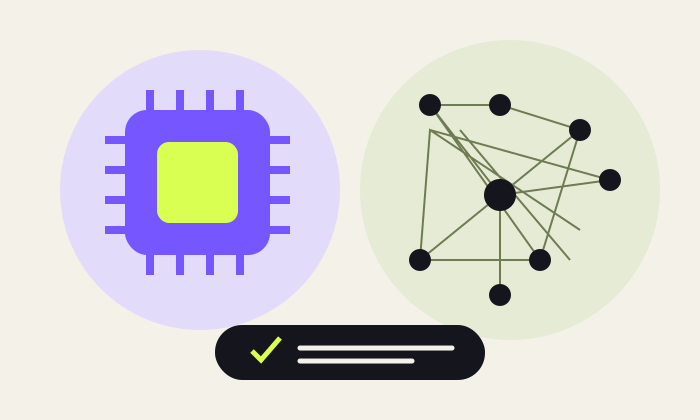
A company wants to classify incoming requests into five categories. A professional wants help examining an ambiguous business problem. Both are language tasks, but they place very different demands on a model. Choosing the largest model for every request can consume resources without improving the result enough to justify the cost.
Use the least resource-intensive model and workflow that reliably meet your quality, security and response-time requirements.
This is the useful meaning of “efficiency over size”. It is a decision about the complete job: preparation, inference, verification, corrections and exceptions.
What are SLMs and LLMs?
A small language model, or SLM, is a relatively compact language model, often designed or adapted for efficient deployment or a focused set of tasks. A large language model, or LLM, generally has greater scale and is often used for broad language and reasoning capabilities. The terms overlap: there is no universally accepted parameter threshold separating them.
Parameters are learned numerical values in the model. They influence capacity and resource requirements, but parameter count alone does not measure useful intelligence. Training data, architecture, task-specific adaptation, context handling and the inference system also matter. Some compact models are general-purpose, and some large models are specialised.
SLM also does not mean open-source, offline or automatically private. Those are separate questions about licensing, deployment and data handling.
The comparison that matters in practice
| Dimension | Smaller-model opportunity | What to check against a larger model |
|---|---|---|
| Focused tasks | Can perform well on a clearly defined extraction, classification or rewriting job. | Whether difficult examples and edge cases expose a quality gap. |
| Response time | Lower compute requirements can help on suitable hardware. | Actual latency under load; an optimised hosted model may be faster than a local one. |
| Cost | Can reduce serving costs for repeatable workloads. | Setup, hardware, maintenance, retries and reviewer time. |
| Deployment | Some models fit on local or edge devices. | Memory, context length, runtime compatibility and supported inputs. |
| Broad reasoning | May be adequate when the task is narrow and evidence is supplied. | Performance on unfamiliar, ambiguous or multi-step problems. |
| Control and privacy | Local deployment can reduce some external data transfers. | Logs, telemetry, plugins, access controls, updates and fallback services. |
| Energy | Smaller inference workloads can offer savings. | Measured energy for the whole workload, including retries and hardware utilisation. |
These are potential trade-offs, not universal rankings. A small model that repeatedly fails a task can be less efficient than a larger model that completes it correctly.
Why compact models can be capable
Better training and a narrower target
A model can concentrate on the language, formats and decisions that matter to a particular workflow. Carefully chosen examples and task-specific training can improve that fit. This does not establish that the model will generalise equally well outside its intended domain.
Distillation transfers useful behaviour
Distillation trains a smaller model using supervision from a stronger model, such as outputs or reasoning-related training examples. Google’s “Distilling step-by-step” research demonstrated task-specific improvements with smaller models on selected benchmarks. Those experimental results support the approach; they do not show that any small model can replace any larger one. [2]
Quantization changes the storage calculation
Quantization represents model values with lower precision to reduce memory requirements. Supported implementations can improve deployment efficiency, with trade-offs depending on the method, hardware and task. A compressed large model has not simply become a newly trained small model. Validate the exact quantized version you intend to deploy. [4]
Architecture changes what “size” means
Mixture-of-experts models activate only part of their parameters for each token. Total parameters, active parameters and memory requirements therefore describe different things. A low active-parameter figure should not be read as a guarantee of a tiny download or low total memory requirement. [5]
Documented examples of the efficiency approach
Phi-3: a historical example of compact capability
Microsoft’s Phi-3 report introduced phi-3-mini with 3.8 billion parameters and described deployment on a phone. Its benchmark comparisons helped illustrate how training could produce useful capability at a compact scale. This is a research example from an earlier generation, not a claim that it is the latest or best model today. [1]
FunctionGemma: specialisation for a defined job
Google’s FunctionGemma announcement describes a compact model focused on function calling and edge use cases. It illustrates a practical division of labour: a lightweight model can translate a common request into a structured tool call, while a more capable system handles harder tasks. The application must still enforce permissions and verify arguments before executing an action. [3]
The limits remain important
Microsoft’s Phi-4 technical report explicitly discusses limitations in factual knowledge and hallucinations, despite strong results on some reasoning tasks. Smaller models need evidence checks; larger models do too. Adding retrieval can help supply relevant information without guaranteeing that the final answer uses it correctly. [6]
Workplace cases: where each approach may fit
These are illustrative design choices to evaluate, not independent benchmark findings.
| Task | Reasonable starting point | Review requirement |
|---|---|---|
| Route requests into a fixed category list | Test a compact classifier or SLM. | Check rare categories and escalate unclear requests. |
| Extract fields from a standard document | Use suitable document extraction plus a model that supports the input. | Validate identifiers, dates and amounts against the original. |
| Draft a routine reminder | Combine a controlled template with a compact model where needed. | Confirm recipient, balance, tone and approval before sending. |
| Investigate conflicting business evidence | Evaluate a stronger reasoning model with access to approved sources. | Check assumptions and evidence; retain professional judgment. |
| Calculate totals or tax amounts | Use verified spreadsheet formulas or deterministic code for arithmetic. | Verify inputs, applicable rules and calculations. |
| Develop and test unfamiliar software | Compare a stronger coding model with a compact alternative on the actual project. | Run meaningful tests and review permissions and security. |
For personal use, a compact local assistant may be useful for rewriting notes or focused study exercises. If you need broader research, difficult reasoning or capabilities your local setup lacks, a hosted model may be more practical. Your device and workflow should determine the choice.
A hybrid workflow can be the efficient choice
Consider an internal service desk. A smaller model assigns a category and extracts required fields. A rules-based validator checks completeness. Ambiguous or complex cases move to a larger model or a person. Consequential actions require approval.
Make the escalation rule explicit. Missing evidence, conflicting values, invalid output formats and known high-risk categories are useful signals. A model’s own confidence statement is not a reliable quality guarantee. Keep examples of failures and test whether the router catches them.
How to evaluate efficiency without fooling yourself
- Define success: specify required fields, acceptable error rates, response time and situations that need human review.
- Build representative examples: include ordinary cases, difficult cases, missing information and instructions the system should decline or escalate.
- Compare the actual deployments: record model version, quantization, prompts, retrieval, hardware and context length.
- Measure the whole job: include retries, corrections, review time, infrastructure and ongoing maintenance.
- Inspect failure severity: a missed comma and an incorrect payment instruction are not equivalent errors.
- Retest changes: repeat relevant checks when the model, inputs, prompts or tools change.
Cost per accepted result = total operating and review cost ÷ number of results accepted under your quality criteria.
Measure end-to-end response time as well as generation speed. Compare the same workload and quality threshold. Avoid claiming energy savings from parameter count alone.
What this means for professional firms
A CA or advisory practice can evaluate compact models for document tagging, task routing and controlled drafting. More complex analysis may warrant a larger model, but both require approved data handling and professional review. Keep calculations in auditable tools and verify legal or tax conclusions against current authoritative sources.
Start with a bounded, non-confidential pilot. If a smaller model meets the acceptance criteria consistently, it earns a place in the workflow. If it creates more correction work than it saves, change the model or redesign the task.
The durable advantage is matching model capability to the work. Efficiency comes from a dependable result delivered with appropriate resources, oversight and control.